How Text-to-Speech and Speech-to-Text Help Businesses Automate Voice Communication
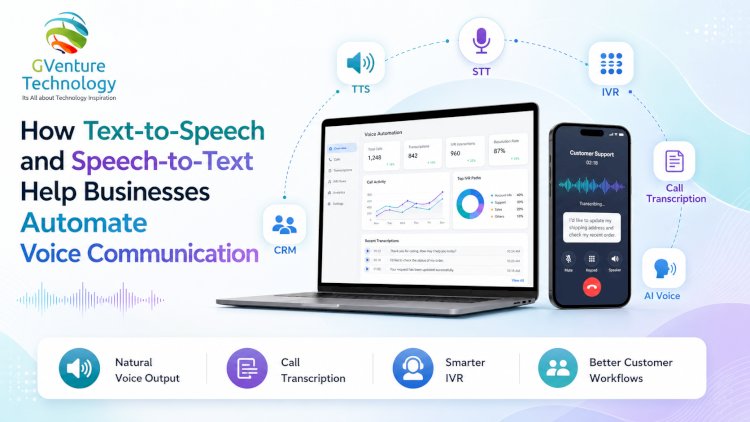
Voice has quietly become one of the most important interfaces in modern business. Every time a customer calls a support line, asks a smart speaker for help, or leaves a voicemail that gets transcribed into a CRM note, two technologies are working behind the scenes: text-to-speech (TTS) and speech-to-text (STT). Together, they form the backbone of voice automation — the ability for machines to listen, understand, and respond to human speech without a person on the other end of the line.
For businesses under pressure to scale support, cut costs, and operate around the clock, TTS and STT aren't just convenient add-ons anymore. They're becoming core infrastructure. This post breaks down what these technologies actually do, why they matter for business operations, and how companies across industries are using them to automate voice communication at scale.
What Text-to-Speech and Speech-to-Text Actually Do
It helps to separate the two technologies clearly, since they solve opposite problems but often work together in the same system.
Text-to-speech (TTS) converts written text into spoken audio. Modern TTS engines use neural networks trained on huge amounts of human speech to produce voices that sound natural, with realistic pacing, intonation, and emotional inflection — a far cry from the robotic, monotone voices of a decade ago. TTS is what allows a chatbot's response to be read aloud, a navigation app to give spoken directions, or an IVR (interactive voice response) system to greet a caller by name.
Speech-to-text (STT), also called automatic speech recognition (ASR), does the reverse: it listens to spoken audio and converts it into written text. This is the technology behind voice assistants that transcribe what you say, call centers that automatically log conversation transcripts, and dictation tools that turn spoken notes into text documents.
When combined, TTS and STT create a full voice loop: a system can listen to what a customer says, process the meaning behind it, and respond with a spoken answer — all without human involvement. That loop is the foundation of most voice automation businesses deploy today.
Why Businesses Are Investing in Voice Automation
A few converging trends explain why TTS and STT have moved from novelty to necessity.
Customer expectations have shifted. People increasingly expect instant responses, regardless of the hour. A voice-automated system doesn't take breaks, doesn't get overwhelmed during peak call volume, and doesn't have a queue that grows every minute after 6 p.m.
Labor costs and staffing challenges are real constraints. Running a large call center is expensive, and hiring, training, and retaining agents is a constant operational challenge. Automating routine, repetitive voice interactions frees human agents to focus on complex or sensitive cases where empathy and judgment genuinely matter.
Voice interfaces are becoming a primary channel, not a secondary one. Smart speakers, in-car assistants, and voice-enabled apps mean customers now expect to interact with brands by talking, not just typing or clicking.
Data went from an afterthought to an asset. Every voice interaction that gets transcribed via STT becomes searchable, analyzable text — a goldmine for understanding customer sentiment, common complaints, and product feedback that used to disappear the moment a phone call ended.
Core Business Use Cases
1. Automated Customer Support and IVR Systems
The most visible application of TTS and STT is in customer support. Modern IVR systems no longer force callers to "press 1 for billing, press 2 for support." Instead, STT lets the caller simply say what they need — "I want to check my order status" — and the system understands the intent, routes the call appropriately, or resolves the request entirely through automation. TTS then delivers the response in a natural-sounding voice, often personalized with the customer's name or account details.
This shift, often bundled under "conversational IVR" or "voice bots," reduces call handling time and cuts the number of calls that need to escalate to a live agent.
2. Call Center Transcription and Quality Assurance
STT is widely used to transcribe every customer service call in real time or shortly after it ends. These transcripts feed into quality assurance programs, compliance monitoring, and coaching for agents. Instead of a supervisor randomly sampling 2% of calls, automated transcription and analysis can review 100% of interactions, flagging calls with negative sentiment, compliance risks, or missed upsell opportunities.
This is particularly valuable in regulated industries like finance and insurance, where call documentation is often a legal requirement, not just a nice-to-have.
3. Voice Assistants and In-App Voice Search
E-commerce platforms, banking apps, and productivity tools increasingly offer voice-driven interfaces. A user can ask an app to "find my last invoice" or "transfer money to savings," and STT converts that spoken request into an actionable command. TTS can then confirm the action verbally, creating a hands-free experience that's especially useful for accessibility and for users multitasking or driving.
4. Multilingual and Global Communication
TTS engines now support dozens of languages and regional accents with increasingly natural pronunciation. This allows a single automated system to serve customers across multiple countries without hiring native-speaking staff for every region. Paired with STT for understanding incoming speech in different languages, businesses can build voice support systems that scale globally rather than market by market.
5. Accessibility and Inclusive Design
TTS makes written content — websites, documents, apps — accessible to users with visual impairments or reading difficulties. STT similarly helps users who have difficulty typing, whether due to a physical disability or simply being on the go. For businesses, building these capabilities isn't just about compliance with accessibility standards like WCAG; it's about not excluding a meaningful segment of potential customers.
6. Employee Productivity and Internal Workflows
Voice automation isn't only customer-facing. Sales teams use STT to transcribe and summarize client calls automatically, feeding notes directly into a CRM without manual data entry. Field workers use voice dictation to log reports hands-free. Meeting transcription tools convert internal discussions into searchable notes and action items, saving hours of manual note-taking across an organization.
7. Marketing and Content Localization
TTS allows marketing teams to generate voiceovers for ads, explainer videos, and audio content at a fraction of the cost and time of hiring voice actors — particularly useful when content needs to be produced in multiple languages or updated frequently. Some brands use consistent, custom AI voices as part of their brand identity, similar to how they'd maintain a consistent visual style.
The Technology Behind the Scenes
Today's TTS and STT systems are largely powered by deep learning models trained on massive datasets of speech and text. Key developments driving quality improvements include:
- Neural TTS models that generate more natural prosody — the rhythm, stress, and intonation of speech — rather than stitching together pre-recorded sound fragments.
- End-to-end STT architectures that process audio directly into text with fewer intermediate steps, improving both speed and accuracy.
- Context-aware language models layered on top of transcription, which help systems understand intent, not just words — critical for distinguishing "I want to cancel my subscription" from "I don't want to cancel my subscription."
- Noise robustness improvements that allow STT systems to perform reliably in call centers, moving vehicles, or noisy public environments.
Businesses typically access these capabilities through cloud APIs from providers, rather than building models from scratch, which has made voice automation accessible even to small and mid-sized companies without dedicated AI teams.
Challenges Businesses Should Plan For
Voice automation isn't plug-and-play, and a few challenges deserve attention before deployment:
Accuracy varies by accent, dialect, and background noise. STT accuracy can drop meaningfully with heavy accents, industry-specific jargon, or poor audio quality, which can frustrate customers if not accounted for during design and testing.
Tone and trust matter. An overly robotic or mismatched voice can undermine customer trust, especially in sensitive contexts like healthcare or financial services. Voice selection and script design deserve real thought, not just default settings.
Escalation paths are essential. No voice automation system should trap a frustrated customer in an endless loop. A clear, fast path to a human agent is critical for both customer satisfaction and brand reputation.
Data privacy and compliance. Voice data often counts as sensitive personal information. Businesses need clear policies on how recordings and transcripts are stored, who can access them, and how long they're retained, particularly under regulations like GDPR or industry-specific rules.
Looking Ahead
As TTS and STT models continue to improve in accuracy and naturalness, the line between automated and human voice interaction will keep blurring. Businesses that get ahead of this shift — building thoughtful, well-tested voice automation rather than bolting it on as an afterthought — stand to gain real advantages: lower operational costs, faster response times, richer customer data, and support that scales without proportionally scaling headcount.
The technology is no longer the limiting factor. The businesses that win with voice automation will be the ones that design these systems around genuine customer needs, not just cost-cutting — using TTS and STT to make communication faster and more accessible, without losing the human touch that still matters most when something goes wrong.
What's Your Reaction?