Is EECP Therapy Painful? What to Expect During Treatment
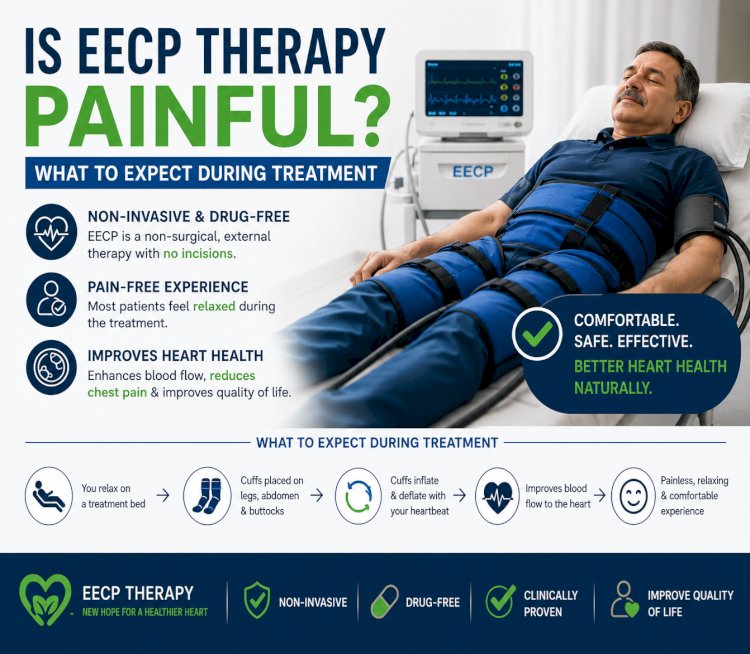
Patients considering EECP treatment often have one immediate question: Does it hurt? Enhanced External Counterpulsation, commonly called EECP or ECP, is a noninvasive outpatient treatment used primarily for selected patients with chronic stable angina. Unlike angioplasty or bypass surgery, it does not involve incisions, needles inside the arteries, general anesthesia, or a hospital stay.
Most patients do not describe EECP as painful. However, the repeated pressure from the treatment cuffs can feel strong or unusual, especially during the first few sessions. Some patients may also experience temporary skin irritation, muscle soreness, or discomfort where the cuffs are positioned.
Knowing exactly what happens before, during, and after treatment can help you decide whether EECP is worth discussing with your cardiologist.
What Is EECP Treatment?
EECP treatment uses three sets of inflatable cuffs placed around the calves, thighs, and lower pelvic area. The cuffs inflate and deflate in precise coordination with the patient’s heartbeat.
During the resting phase of the heartbeat, the cuffs inflate sequentially from the lower legs upward. This action helps move blood toward the heart. Just before the heart contracts, the cuffs rapidly deflate, which may reduce resistance against the heart’s pumping action.
Cleveland Clinic describes EECP as an outpatient therapy for chronic stable angina that applies pressure to the lower limbs to support blood flow.
The treatment does not open an artery mechanically in the way that a stent does. Instead, it aims to improve circulation and reduce symptoms in appropriately selected patients.
Is External Counterpulsation Therapy Painful?
For most patients, external counterpulsation therapy is not considered painful.
The sensation is often described as:
- Firm squeezing around the legs
- Rhythmic pressure moving upward
- A tight massage-like feeling
- Strong compression synchronized with the heartbeat
The pressure can take time to get used to. During the first session, the treatment team may adjust the cuff intensity to help the patient remain comfortable while still achieving effective counterpulsation.
You remain awake throughout treatment and can usually talk, listen to music, watch television, or rest.
Tell the clinical team immediately if you experience sharp pain, numbness, severe pressure, breathing difficulty, or worsening chest discomfort.
What Happens Before the First Session?
Before beginning treatment, patients should receive a cardiovascular evaluation to confirm that EECP is appropriate.
The assessment may include:
- Review of angina symptoms
- Medication history
- Blood pressure measurement
- Electrocardiogram
- Heart function testing
- Review of previous angioplasty or bypass procedures
- Examination of leg circulation
- Assessment for conditions that may make treatment unsuitable
EECP is generally considered for people with chronic stable angina that continues despite appropriate medical therapy, particularly when additional revascularization procedures are not suitable. FDA device information describes external counterpulsation systems for chronic stable angina that remains refractory to optimal anti-anginal therapy when revascularization options are unavailable.
It should not be started simply because someone has occasional unexplained chest pain.
What Happens During an EECP Session?
At the beginning of the appointment, you will usually change into fitted treatment clothing designed to reduce friction between the cuffs and skin.
The clinical team then places cuffs around your:
- Calves
- Lower thighs
- Upper thighs and buttocks
Electrodes are placed on the chest to monitor the heartbeat, and a blood pressure sensor may be attached to a finger.
Once the system begins:
- The machine detects each heartbeat.
- The cuffs inflate during the heart’s relaxation phase.
- Pressure moves upward from the calves toward the upper legs.
- The cuffs deflate just before the next heartbeat.
University of Michigan Health explains that EECP uses three pairs of inflatable cuffs around the legs and buttocks that continuously inflate and deflate in rhythm with the heartbeat.
A typical session lasts about one hour.
How Many Sessions Are Usually Needed?
A commonly used treatment course is approximately 35 one-hour sessions, often scheduled five days per week for seven weeks.
However, the schedule may vary based on:
- The patient’s condition
- Treatment tolerance
- Clinical recommendations
- Missed appointments
- The provider’s protocol
Consistency matters because EECP is generally delivered as a complete course rather than an occasional treatment.
Patients should ask the provider how many sessions are recommended and what happens if the schedule is interrupted.
Possible Side Effects and Discomfort
Although EECP is noninvasive, side effects can occur.
Possible temporary effects include:
- Skin redness
- Bruising
- Chafing
- Leg soreness
- Muscle fatigue
- Pressure discomfort
- Back discomfort
- Tingling beneath the cuffs
The treatment team may use padding, adjust cuff placement, modify pressure, or recommend different clothing to reduce discomfort.
Patients taking blood-thinning medication or those who bruise easily should tell the provider before treatment begins.
Severe pain is not something you should simply tolerate. It may indicate poor cuff positioning, excessive pressure, or an underlying condition requiring evaluation.
Who May Not Be an Appropriate Candidate?
EECP is not suitable for everyone.
A cardiologist may advise against or postpone treatment for patients with certain conditions, potentially including:
- Significant aortic valve insufficiency
- Uncontrolled high blood pressure
- Irregular heart rhythms that interfere with machine timing
- Active blood clots
- Severe peripheral artery disease
- Recent vascular surgery
- Pregnancy
- Certain severe heart failure conditions
- Active bleeding problems
Eligibility should always be determined through an individualized medical assessment.
How Soon Might Patients Notice Results?
Some patients report improvement during the treatment course, while others notice changes after completing all sessions.
Potential improvements may include:
- Fewer angina episodes
- Increased walking tolerance
- Reduced need for fast-acting angina medication
- Improved ability to perform daily activities
- Better quality of life
Results differ from person to person, and benefit is not guaranteed.
EECP should be viewed as part of a larger care plan that may include medication, nutrition, physical activity, smoking cessation, and management of blood pressure, cholesterol, and diabetes.
Can EECP Help Reverse Heart Disease Naturally?
People researching ways to reverse heart disease naturally may encounter claims that EECP creates a “natural bypass.” That phrase can be misleading when interpreted literally.
EECP may support circulation and reduce chronic angina symptoms in selected patients, but it does not directly remove plaque from coronary arteries or replace guideline-directed medical care.
Healthy lifestyle measures remain essential:
- Eat a heart-healthy diet.
- Stop smoking.
- Exercise under medical guidance.
- Control blood pressure.
- Manage cholesterol and diabetes.
- Maintain a healthy weight.
- Take prescribed medication consistently.
Patients should be cautious of any provider promising that EECP permanently cures coronary artery disease.
Understanding EECP Therapy Cost
EECP therapy cost varies according to the treatment center, geographic location, number of sessions, insurance status, and clinical eligibility.
Medicare provides coverage for certain patients with disabling stable angina who meet defined criteria and are not readily suitable for surgical intervention. Coverage does not automatically apply to every patient or every advertised use of EECP.
Before treatment, ask the center for:
- Total estimated cost
- Cost per session
- Number of recommended sessions
- Insurance preauthorization requirements
- Deductible or copayment estimates
- Cancellation policies
- Charges for the initial consultation or testing
Avoid choosing a provider based solely on the lowest advertised price.
How to Choose a Treatment Center
Searching online for ECP therapy near me can identify nearby clinics, but location should not be the only deciding factor.
Ask potential providers:
- Is treatment supervised by qualified medical professionals?
- Is a cardiology evaluation required?
- What conditions do you treat with EECP?
- How do you monitor patients during sessions?
- What happens if chest pain develops during treatment?
- How many sessions are included?
- What side effects should I report?
- Will you coordinate care with my cardiologist?
- What are the complete costs and insurance requirements?
A trustworthy clinic should explain both the potential benefits and limitations of treatment.
Final Thoughts
For most eligible patients, EECP treatment is not painful, although the rhythmic compression can feel strong and may cause temporary soreness, bruising, or skin irritation. The procedure is noninvasive, performed while the patient is awake, and usually requires no recovery period after each appointment.
Still, EECP is a medical therapy—not a spa treatment or universal cure. Before searching for ECP therapy near me, obtain a complete cardiovascular evaluation and discuss whether external counterpulsation therapy fits your diagnosis, symptoms, and treatment history.
Understanding the expected schedule, possible discomfort, realistic benefits, and complete EECP therapy cost will help you make a more informed decision with your cardiologist.
Frequently Asked Questions
Does EECP hurt during treatment?
Most patients experience firm rhythmic pressure rather than pain. Mild soreness, bruising, or skin irritation can occur, but sharp or severe pain should be reported immediately.
Can I go home after an EECP session?
Yes. EECP is normally performed as an outpatient treatment, and most patients can resume regular activities after the session unless their healthcare provider advises otherwise.
Is EECP an emergency treatment for chest pain?
No. EECP is not used to treat an active heart attack or unstable chest pain. Call 911 for new, severe, persistent, or worsening chest discomfort.
Does insurance cover EECP?
Coverage depends on the diagnosis, clinical criteria, insurance plan, and provider. Ask the clinic and insurer to confirm authorization and expected out-of-pocket costs before treatment.
What's Your Reaction?