Understanding AI Agents: How They Work and Why They Matter
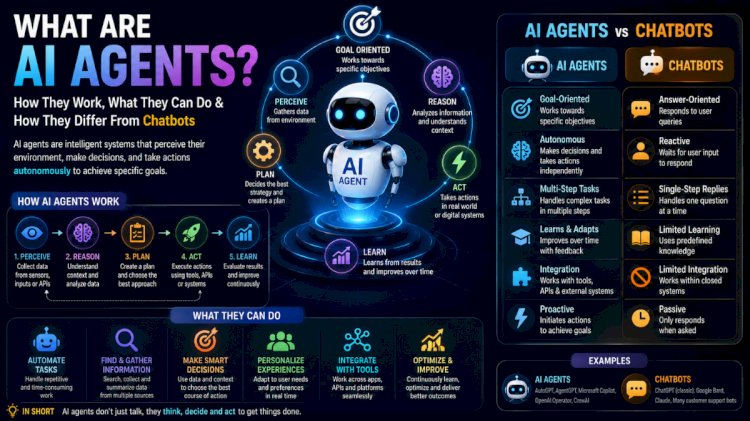
Artificial Intelligence (AI) is moving beyond simple chatbots and automated tools with the rise of AI agents. AI agents are advanced systems that can understand goals, make decisions, use different tools, and complete tasks with limited human involvement. They are changing how businesses, professionals, and everyday users interact with technology.
What Are AI Agents?
AI agents are intelligent software systems designed to perform tasks independently by understanding instructions, analyzing information, planning actions, and achieving specific goals. Unlike traditional AI tools that only respond to user commands, AI agents can take multiple steps to complete a task.
For example, a chatbot may answer a question like “What is the weather today?” but an AI agent can check weather updates, analyze travel conditions, suggest the best time to leave, and even help modify a travel plan.
AI agents combine technologies such as machine learning, natural language processing, reasoning systems, and external tools to complete complex tasks. They are designed to act more like digital assistants that can think, plan, and execute actions.
How Do AI Agents Work?
AI agents work through a combination of understanding, decision-making, and action. They follow a process that allows them to complete tasks efficiently.
The basic working process of AI agents includes:
- Understanding Goals: AI agents first analyze user instructions and understand what needs to be achieved.
- Planning Actions: They create a step-by-step strategy to complete the given task.
- Using Tools: AI agents can connect with databases, applications, websites, software tools, and APIs to collect information or perform actions.
- Learning and Improving: Many AI agents use feedback and past experiences to improve their future performance.
- Completing Tasks: After analyzing information and taking necessary actions, they provide results or complete the required work.
For instance, an AI agent for customer support can understand a customer complaint, search company records, identify the problem, suggest solutions, and update the support system automatically.
Difference Between AI Agents and Chatbots
Although AI agents and chatbots are related to artificial intelligence, they work differently. Chatbots mainly focus on conversations, while AI agents focus on completing tasks.
Traditional chatbots usually follow predefined responses or answer questions based on available information. They are useful for basic customer support, FAQs, and simple interactions.
AI agents are more advanced because they can:
- Make independent decisions based on goals.
- Perform multiple actions without continuous instructions.
- Access external tools and applications.
- Handle complex tasks requiring planning and reasoning.
A chatbot may tell a user how to book a flight, while an AI agent can search flights, compare prices, prepare options, and assist with the booking process.
Why AI Agents Matter Today
AI agents are becoming important because they can save time, increase productivity, and automate complicated tasks. Businesses are using them to improve operations, reduce costs, and provide faster services.
In the workplace, AI agents can help employees with tasks such as research, data analysis, scheduling meetings, writing reports, and managing workflows. This allows people to focus more on creative and strategic work.
Some major areas where AI agents are making an impact include:
- Healthcare: AI agents can help doctors analyze medical information, manage patient records, and support research.
- Business: Companies use AI agents for customer service, sales support, and data management.
- Education: AI agents can provide personalized learning support for students.
- Finance: They can assist with financial analysis, fraud detection, and automated services.
- Software Development: AI agents can help developers write code, find errors, and improve applications.
Real-World Examples of AI Agents
Many technology companies are developing AI agent systems that can perform advanced tasks. These systems are being used in different industries to improve efficiency.
For example, an AI research assistant can collect information from multiple sources, summarize findings, and create reports. A business AI agent can monitor market trends and provide recommendations. A personal AI agent can organize schedules, manage emails, and help users complete daily tasks.
The future of AI is expected to move toward more autonomous agents that can work together, solve complex problems, and manage entire workflows.
Challenges of AI Agents
Despite their benefits, AI agents also create new challenges. Since they can make decisions and perform actions independently, ensuring accuracy, security, and responsible use is important.
Some key challenges include:
- Protecting user privacy and sensitive information.
- Preventing incorrect decisions caused by inaccurate data.
- Maintaining human control over important actions.
- Reducing risks of misuse or security threats.
Developers and organizations need strong safety measures to ensure AI agents are reliable and transparent.
The Future of AI Agents
AI agents represent the next stage of artificial intelligence development. Instead of only responding to commands, future AI systems will become more proactive and capable of managing complex tasks independently.
As technology improves, AI agents may become common digital partners for individuals and businesses. They could help people manage work, make better decisions, and solve problems faster.
The growth of AI agents does not mean replacing humans completely. Instead, these systems are expected to work alongside people by handling repetitive tasks and providing intelligent support.
Conclusion
AI agents are transforming the way people use artificial intelligence by moving from simple question-answer systems to intelligent task-performing assistants. Their ability to understand goals, plan actions, and use tools makes them powerful technologies for the future.
As AI agents continue to develop, they will play an important role in businesses, education, healthcare, and everyday life. Understanding how they work today can help people prepare for a future where humans and AI collaborate more closely.
What's Your Reaction?