What Is EMS for Hospitals and How Does Electronic Management Software Work?
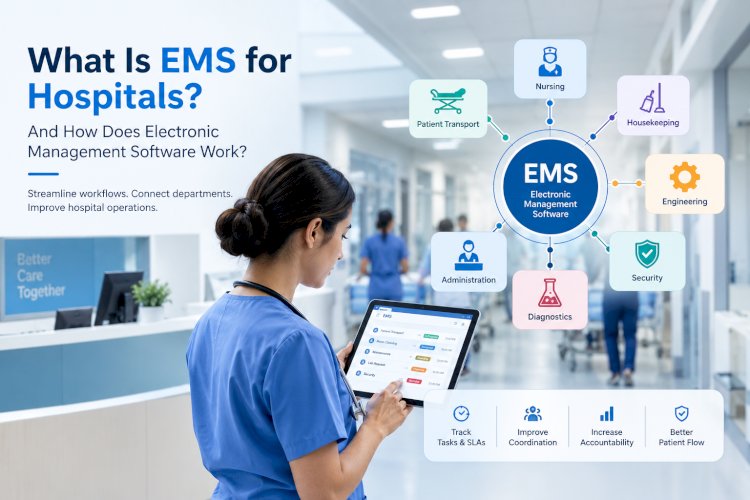
EMS for Hospitals, or Electronic Management Software, is a digital system that coordinates hospital-wide operational workflows across clinical, administrative, and support departments. It assigns tasks, tracks requests, manages approvals and service-level agreements, monitors delays, and creates an auditable record of actions. Unlike an HMS that primarily manages clinical and administrative transactions, EMS focuses on coordinating the work that happens between departments.
Hospitals are made up of many interconnected departments. Doctors, nurses, laboratories, pharmacies, billing teams, housekeeping staff, transport teams, engineering departments, security personnel, and administrators all contribute to the patient journey.
The challenge is that these teams often depend on each other.
A patient may need to be transferred from one department to another. A room may need cleaning before the next admission. A diagnostic request may require coordination between nursing and laboratory teams. A discharge may depend on several departments completing their tasks.
When these activities are managed through phone calls, paper requests, spreadsheets, verbal handovers, or disconnected messaging channels, it can become difficult to know:
- Who is responsible for a task?
- When should it be completed?
- Has someone accepted the request?
- Is the task delayed?
- Which department is causing the bottleneck?
- What happened during the process?
This is where Electronic Management Software can provide an operational layer for hospitals.
Rather than replacing the hospital's existing HMS or EMR, EMS can work alongside them to coordinate cross-department activities and make operational workflows more visible and measurable.
What Is EMS for Hospitals?
EMS for Hospitals is an Electronic Management Software platform designed to coordinate, track, and manage operational workflows across hospital departments.
It can digitize activities such as:
- Service requests
- Task assignment
- Department routing
- Approvals
- Dispatch
- Escalations
- SLA tracking
- Patient-support services
- Housekeeping requests
- Transport requests
- Engineering requests
- Security coordination
- Operational reporting
- Audit trails
The main objective is to create a single operational view of work that may otherwise be scattered across departments.
MediTale describes EMS as the “connective tissue” between hospital departments, turning informal calls and paper-based requests into traceable workflows with ownership and measurable outcomes.
How Does Electronic Management Software Work in a Hospital?
Electronic Management Software generally works by turning an operational request into a structured digital workflow.
A simplified EMS process looks like this:
Request → Route → Assign → Acknowledge → Execute → Track → Escalate if required → Complete → Analyze
For example, suppose a patient needs transportation from a ward to a diagnostic department.
Instead of a staff member making multiple phone calls, an EMS workflow can allow the request to be entered digitally.
The system can then:
- Capture the request
- Identify the relevant department
- Assign the task
- Notify the responsible team
- Start an SLA timer
- Track progress
- Escalate an overdue request
- Record completion
- Store the activity history
- Provide performance data for management
This creates a traceable workflow instead of relying entirely on verbal communication.
Digital workflow design is also consistent with broader digital-health architecture. WHO describes workflow and algorithm components as mechanisms that can automate information flow, connect previously siloed applications, and support efficient health-service processes.
What Problems Does EMS Solve in Hospitals?
Hospitals can have sophisticated clinical systems and still experience operational gaps.
For example, an HMS may contain a patient's admission information, while an EMR contains clinical information. But the operational task of moving the patient, preparing the room, coordinating support services, or completing an approval may still depend on manual communication.
EMS addresses these gaps by focusing on how work moves between people and departments.
Common operational problems include:
1. Unclear Task Ownership
When a request is communicated verbally, it may not be immediately clear who owns it.
EMS assigns requests to responsible departments, teams, or individuals.
2. Delayed Responses
A request may remain pending because nobody notices that it has not been completed.
EMS can use timers, reminders, overdue alerts, and escalation rules.
3. Poor Visibility
Hospital managers may not know how many requests are pending or which departments are overloaded.
EMS dashboards can provide current operational information.
4. Duplicate Communication
Multiple phone calls or messages can be required to determine the status of a request.
A centralized digital queue provides a shared view of the task.
5. Difficult Audits
Paper-based processes can make it difficult to reconstruct who performed an action and when.
Digital activity histories provide structured records.
What Are the Main Features of EMS for Hospitals?
The exact features vary by software provider, but a hospital EMS platform commonly includes several core capabilities.
1. Workflow Orchestration
Workflow orchestration is the foundation of EMS.
It defines:
- What needs to happen
- Who should perform it
- In what order
- Within what timeframe
- What happens if the task is delayed
For example:
Patient discharge initiated → Billing clearance → Pharmacy clearance → Transport request → Room cleaning → Bed status updated
Instead of managing each step independently, EMS can coordinate the overall workflow.
2. Task and Request Management
Hospitals generate thousands of operational requests.
These may include:
- Patient transport
- Housekeeping
- Maintenance
- Equipment support
- Security
- Room preparation
- Supply requests
- Internal transfers
EMS provides a structured way to create, assign, track, and close these requests.
3. SLA Management
SLA stands for Service Level Agreement.
In a hospital environment, an SLA can define how quickly a particular operational request should be acknowledged or completed.
For example:
| Request | Example Target |
|---|---|
| Patient transport | Defined response time |
| Room cleaning | Defined turnaround time |
| Maintenance issue | Priority-based response |
| Security request | Urgent response |
| Equipment support | Defined service window |
The actual targets should be configured according to the hospital's own policies.
An EMS platform can monitor these timeframes and flag overdue activities.
4. Dispatch and Routing
Large hospitals may have multiple teams responsible for different services.
Electronic Management Software can route requests based on:
- Department
- Location
- Priority
- Service type
- Assigned team
- Availability
- Escalation rules
MediTale's EMS, for example, describes centralized intake, department routing, acknowledgements, SLA timers, overdue alerts, and task links to locations, beds, and assets.
5. Approval Workflows
Some hospital activities require authorization before execution.
EMS can create predefined approval workflows.
For example:
Request → Supervisor approval → Department approval → Execution → Completion
This can be useful for sensitive or high-value operational activities.
It also creates a record of the approval process.
6. Real-Time Operational Dashboards
Hospital leadership needs visibility into what is happening now, not only what happened yesterday.
An EMS dashboard can show information such as:
- Pending tasks
- Completed tasks
- Overdue requests
- SLA performance
- Department workload
- Open service requests
- Bottlenecks
- Turnaround times
This allows supervisors to identify operational problems earlier.
WHO also emphasizes the importance of digital health solutions that support informed decision-making and interoperability between systems.
Which Hospital Departments Can Use EMS?
One of the major advantages of EMS is that it can support workflows that cross departmental boundaries.
Nursing
Nursing teams can create and monitor requests related to patient movement, support services, and other operational activities.
Housekeeping
Housekeeping teams can receive room-cleaning requests, update status, and manage turnaround workflows.
Patient Transport
Transport teams can receive assigned requests, view locations, and update progress.
Engineering
Maintenance and engineering teams can manage service requests and track response times.
Security
Security-related operational requests can be routed to appropriate teams with escalation rules.
Diagnostics
EMS can help coordinate operational handoffs related to diagnostic services.
Billing and Administration
Administrative teams can participate in approval, discharge, and other cross-department workflows.
Hospital Command Centers
Command teams can use centralized dashboards to monitor hospital-wide operational performance.
The important point is that EMS is not limited to one department. Its value comes from coordinating activities between departments.
How Is EMS Different From HMS?
EMS and HMS are related but serve different purposes.
| EMS | HMS |
|---|---|
| Focuses on operational workflows | Focuses on hospital management functions |
| Coordinates cross-department tasks | Manages clinical and administrative transactions |
| Tracks task ownership and SLAs | Manages patient and departmental records |
| Manages dispatch and escalations | Supports billing, registration, clinical workflows, etc. |
| Focuses on operational visibility | Provides broader hospital information management |
| Tracks who needs to act next | Records and processes hospital transactions |
An HMS can tell you that a patient has been admitted.
EMS can help coordinate the operational work that needs to happen around that admission.
For this reason, EMS should not necessarily be viewed as a replacement for HMS.
It can instead function as an operational coordination layer alongside HMS and EMR systems. MediTale specifically positions EMS in this way.
How Does EMS Improve Patient Flow?
Patient flow involves much more than moving a patient from one location to another.
It can include:
Registration → Consultation → Diagnostics → Treatment → Admission → Transfer → Discharge
At several points, the process depends on support teams.
For example, a delayed diagnostic preparation or transport request can affect the patient's overall journey.
EMS can make these operational dependencies more visible.
If a task remains pending beyond its expected timeframe, the system can flag the issue so the responsible team or supervisor can take action.
This does not automatically guarantee shorter patient waiting times. However, better visibility, ownership, and coordination can help hospitals identify operational delays and address their causes.
MediTale describes this approach as using centralized operational data to improve handoffs and reduce patient-visible delays caused by internal work waiting for an owner.
How Does EMS Improve Hospital Accountability?
Accountability is another important part of Electronic Management Software.
Consider a paper-based maintenance request.
After several days, management may ask:
Who received the request?
When was it assigned?
Who worked on it?
Why was it delayed?
When was it completed?
If the process was managed through verbal communication, answering these questions may require manually reconstructing events.
An EMS platform can maintain structured records showing:
- Request creation
- Assignment
- Acknowledgement
- Status changes
- Approvals
- Escalations
- Completion
- User activity
This creates an operational audit trail.
MediTale's EMS page highlights role-based access, configurable approval chains, activity history, and policy-based workflows as governance capabilities.
Can EMS Integrate With HMS and EMR?
Yes. Integration is an important consideration when selecting EMS software.
EMS can potentially use information from existing systems to ensure that operational tasks reflect the current hospital situation.
Common integration areas include:
- HMS
- EMR/EHR
- Patient location
- Bed status
- Orders
- User identity systems
- Single sign-on
- Notification platforms
For example, when an operational request is associated with a patient, having relevant patient or location context can help the responsible team complete the task correctly.
WHO identifies interoperability and data exchange as important considerations when implementing digital health solutions.
MediTale also states that its EMS can integrate with HMS/EMR for patient context and location, as well as identity and notification systems.
What Are the Benefits of EMS for Hospitals?
A well-designed EMS platform can provide several operational benefits.
Improved Efficiency
Digital task routing can reduce repetitive phone calls and manual follow-ups.
Better Visibility
Managers can see pending work, workload, SLA performance, and operational bottlenecks.
Clearer Ownership
Every request can have an identifiable owner or responsible team.
Reduced Operational Delays
Alerts and escalation workflows can help bring attention to overdue requests.
Better Cross-Department Coordination
Teams can work from shared task information rather than disconnected communication channels.
Stronger Accountability
Digital records can show what happened and when.
Data-Driven Improvement
Hospitals can analyze turnaround times, backlogs, and SLA performance to identify areas for process improvement.
How Should a Hospital Choose the Right EMS Software?
Hospitals should evaluate EMS based on actual operational requirements rather than simply selecting the software with the largest feature list.
Consider these factors:
Workflow Coverage
Does the system support your real hospital workflows?
HMS and EMR Integration
Can it exchange the information needed to keep operational tasks aligned with clinical systems?
Ease of Use
Can nurses, ward staff, supervisors, and support teams use it without unnecessary complexity?
Mobile Accessibility
Can field and bedside teams update tasks while moving around the hospital?
SLA Management
Can the system configure response times, reminders, escalations, and priority rules?
Reporting
Can management measure turnaround times and identify bottlenecks?
Security
Does the platform provide appropriate access controls, encryption, monitoring, and audit capabilities?
Scalability
Can it support additional departments, towers, campuses, or hospitals as the organization grows?
WHO's digital health assessment framework highlights functionality, interoperability, scalability, privacy, security, and patient safety as important considerations when assessing digital health solutions.
What Does the Future of EMS for Hospitals Look Like?
Hospital EMS is moving toward more connected, mobile, and data-driven operations.
Future-oriented platforms may increasingly use:
- Cloud-based access
- Mobile workflows
- Real-time dashboards
- Intelligent routing
- Predictive operational analytics
- Automated escalations
- Cross-campus reporting
- AI-assisted prioritization
- Integration with clinical systems
The important foundation remains structured operational data.
Once requests, timestamps, ownership, SLA performance, and outcomes are recorded consistently, hospitals can analyze that information to identify recurring bottlenecks and improve processes.
MediTale describes this progression as define and route → execute and track → measure and improve, with intelligent routing available where enabled.
Final Takeaway
EMS for Hospitals is an operational coordination system that helps hospitals manage the work happening between departments.
While HMS and EMR platforms manage important patient, clinical, financial, and administrative information, Electronic Management Software focuses on coordinating tasks, requests, approvals, dispatch, SLAs, escalations, and operational accountability.
The basic concept is simple:
Create the request → assign the owner → track the work → monitor the SLA → escalate delays → record completion → analyze the results.
For hospitals dealing with disconnected communication, unclear task ownership, operational delays, and limited visibility across support services, EMS can provide a structured digital workflow.
The strongest EMS implementation is not simply about digitizing paperwork. It is about creating a shared operational view that helps hospital teams coordinate work with greater consistency, visibility, and accountability.
Frequently Asked Questions About EMS for Hospitals
What does EMS stand for in hospitals?
EMS in this context stands for Electronic Management Software. It is designed to coordinate hospital operational workflows, including requests, task assignments, dispatch, approvals, SLA tracking, escalations, and audit trails.
What is EMS for Hospitals used for?
EMS for Hospitals is used to coordinate cross-department operational activities such as patient transport, housekeeping, engineering, security, service requests, approvals, and other support workflows.
Is EMS the same as HMS?
No. HMS generally focuses on hospital management functions such as patient records, registration, billing, and departmental transactions. EMS focuses more specifically on cross-department operational coordination and task management.
Can EMS work with an existing HMS?
Yes. EMS can be designed to work alongside an existing HMS and EMR. Integration can allow operational workflows to use relevant patient, location, order, and bed information.
How does EMS reduce hospital delays?
EMS can help identify pending tasks, assign ownership, track SLAs, send reminders, and escalate overdue requests. This gives supervisors greater visibility into operational bottlenecks.
Can EMS be used for housekeeping?
Yes. Hospital housekeeping is a common operational use case. EMS can receive cleaning requests, route them to the appropriate team, track status, and monitor turnaround times.
Does EMS support hospital transport?
Yes. An EMS platform can digitize transport requests, assign them to appropriate teams, track progress, and connect requests with relevant patient or location information where integrated.
Why are SLA tracking and escalation important in hospitals?
SLA tracking establishes expected response or completion times. Escalation helps bring attention to requests that exceed those defined timeframes.
Is EMS useful for multi-location hospital groups?
It can be. Multi-site EMS platforms can provide standardized workflows and governance while allowing individual locations to maintain specific routing or service rules.
What should hospitals look for in EMS software?
Hospitals should evaluate workflow coverage, ease of use, HMS/EMR integration, SLA management, mobile capabilities, dashboards, security, audit trails, scalability, and vendor support.
What's Your Reaction?